Year-end reviews typically focus on outcomes. Sales achieved. Markets entered. Products launched. Revenue generated. These results matter—they define whether 2025 was successful.
But honest year-end reviews should also examine enablers. Did the software systems supporting operations keep pace with business growth? Where did manual workarounds become necessary? Which processes slowed as volumes increased?
These questions reveal whether current distribution management systems can support planned 2026 growth—or whether software limitations will constrain next year’s ambitions.
Questions Year-End Should Answer
Distribution software systems either enable growth or constrain it. Year-end provides the perspective needed to assess which category current systems fall into.
Did distribution software keep pace with business growth? Operations that expanded significantly in 2025 placed new demands on underlying systems. Transaction volumes increased. User counts grew. Data quantities multiplied. The system that handled January’s load faced very different requirements by December.
Where did manual workarounds become necessary? Workarounds indicate gaps between what software should handle and what it actually can do. Each workaround represents operational friction, error risk, and wasted time. A few workarounds are manageable. Many workarounds signal that the system isn’t meeting business needs.
Which processes slowed down as volumes increased? System performance degradation under load is common with software not designed for scale. Order processing that took seconds might now take minutes. Reports that generated instantly might require hours. These slowdowns affect productivity and frustrate users.
What integration gaps created visibility problems? Modern distribution involves multiple systems—logistics providers, payment gateways, regional compliance platforms. When these systems don’t integrate well with distribution management software, information remains siloed. Manual compilation becomes necessary. Visibility suffers.
Where did regional expansion face system limitations? Adding new regions should be straightforward. But many distribution systems were designed assuming single-region operation. Multi-currency support might be lacking. Regional tax calculation might require custom development. Each new region becomes a system project rather than a configuration exercise.
Common software infrastructure limitations emerge from year-end reflection. Performance degradation as transaction volumes tripled. Regional expansion constrained by software capabilities that assume uniform operations. Multi-currency operations requiring manual tracking and reconciliation. Integration gaps with new logistics providers creating blind spots. Reporting limitations forcing continued reliance on spreadsheet compilation.
These limitations weren’t deal-breakers at smaller scale. But as operations grew, each constraint became more expensive in time, effort, and opportunity cost.
Cloud-Based Software Advantages
Cloud-based distribution management systems address many limitations that on-premise systems struggle with.
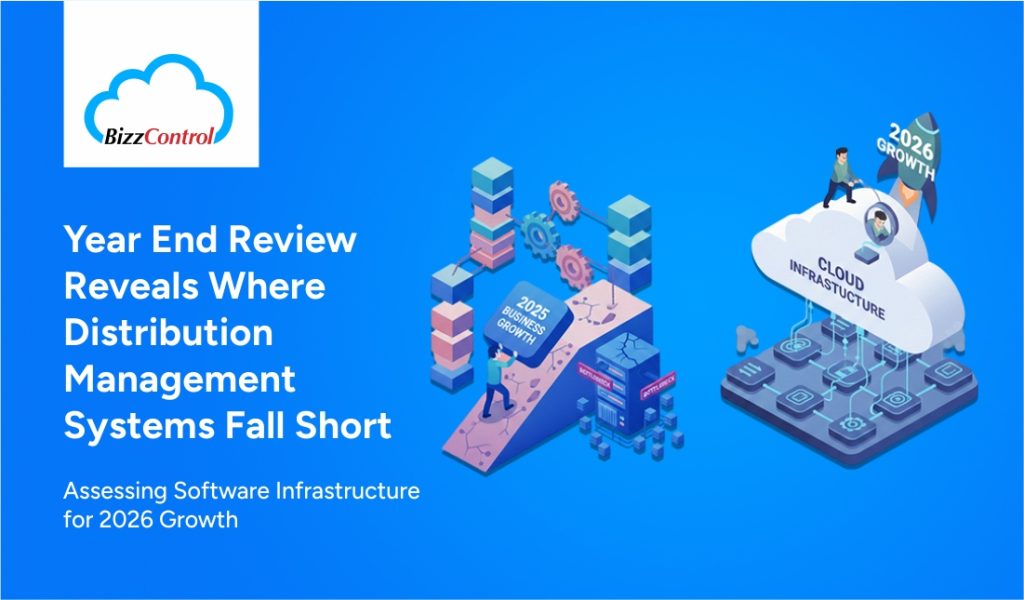
Scalability without server infrastructure investment represents a fundamental advantage. When transaction volumes increase, cloud systems allocate additional computing resources automatically. No need to purchase servers, expand data centers, or plan capacity upgrades. The infrastructure scales transparently based on actual usage.
Regional deployment happens through software configuration rather than installation projects. Adding a new region doesn’t require setting up local servers or managing distributed infrastructure. Users in new regions connect to the same cloud platform. Configuration handles regional variations in processes, currency, and compliance.
Automatic performance optimization as volumes grow is built into cloud architecture. Database queries optimize themselves. Resource allocation adjusts to usage patterns. What would require significant IT effort in on-premise systems happens automatically in well-designed cloud platforms.
Built-in integration capabilities simplify connections to external systems. Modern cloud platforms provide API frameworks designed specifically for integration. Connecting to regional logistics providers, payment systems, or compliance platforms becomes configuration work rather than custom development projects.
Real-time reporting across operations eliminates the lag common with on-premise systems. Data from all regions and channels is immediately available. Consolidation happens automatically. Reports reflect current operations, not yesterday’s batch updates.
Multi-currency support as a standard software feature means international operations or cross-border transactions don’t require workarounds. Currency conversion, exchange rate management, and multi-currency financial reporting are built into the platform rather than added through custom modifications.
Reduced IT burden from system maintenance is significant. Cloud providers handle server maintenance, security patches, backup procedures, and disaster recovery. Internal IT teams focus on business needs rather than infrastructure management. This becomes especially valuable for organizations expanding into new regions where IT resources might be limited.
Geographic flexibility supports multi-region operations naturally. Cloud platforms with distributed data centers ensure good performance regardless of where users are located. Latency issues from physical distance minimize. Regional teams get responsive system access without local server infrastructure.
Software System Investment ROI
Assessing whether to upgrade distribution software involves calculating return on investment beyond just licensing costs.
Time saved from eliminating manual processes represents direct productivity gain. Each workaround eliminated returns time to value-creating activities. When dozens of people spend hours weekly on manual processes that automated systems would handle, the annual cost is substantial.
Faster decision-making from better data access provides competitive advantage. When information is immediately available rather than requiring compilation, responses to market changes accelerate. Opportunities get captured faster. Problems get addressed sooner.
Expansion speed enabled by flexible software systems directly affects growth trajectory. If system limitations delay regional rollout by two months, that’s two months of missed revenue and market opportunity. When expansion is configuration rather than installation projects, time to market shortens significantly.
Error reduction from systematic processes improves both cost and customer experience. Manual processes create mistakes. Data entry errors. Calculation mistakes. Information gaps. Automated systematic processes eliminate most error sources. The cost savings from reducing errors—and the relationship benefits from better accuracy—add up quickly.
Operational efficiency from unified visibility means less time spent searching for information, reconciling inconsistencies, and coordinating across silos. When everyone works from the same current data, coordination overhead drops significantly.
Cost comparison between workarounds and proper distribution software often surprises organizations. The accumulated cost of maintaining workarounds, handling errors they create, and absorbing the inefficiency they cause frequently exceeds software investment costs. But workaround costs are hidden in operational budgets while software costs are explicit investment decisions.
Strategic advantage from better information access is harder to quantify but often most valuable. Organizations with superior distribution intelligence make better decisions than those flying partially blind. Over time, this intelligence advantage compounds into market position advantage.
BizzControl for Growing Operations
BizzControl is designed specifically for manufacturers whose distribution operations are growing in scale and complexity.
Cloud-based distribution management software provides the scalability advantages described earlier. No infrastructure investment required for expansion. Automatic performance maintenance as volumes grow. Reduced IT burden from cloud provider handling maintenance and updates.
Multi-region support is built into the platform rather than added through customization. Different regions can have different tax structures, pricing rules, and operational workflows while maintaining unified visibility. Regional deployment is configuration work, not development projects.
Scalable software architecture maintains performance as transaction volumes increase significantly. The database design handles large datasets efficiently. Concurrent user access across regions doesn’t degrade response times. The performance characteristics that work at current scale continue working at 2X and 3X volumes.
Integration framework for regional logistics enables connections to different providers across geographies without custom development projects. APIs facilitate data exchange. Pre-built connectors to common platforms reduce implementation time. Different regions can work with different logistics providers while maintaining centralized visibility.
Multi-currency operations are handled natively within the platform. Pricing in multiple currencies. Order processing in local currency. Automatic currency conversion for consolidated reporting. Exchange rate management built in rather than bolted on.
Unified visibility across distributed operations means management can see consolidated performance while maintaining ability to drill down into regional, distributor, or product-level detail. The system aggregates without losing granularity.
Configuration-based regional deployment allows regional teams to adapt workflows and rules to local requirements without forking the codebase or creating maintenance nightmares. Flexibility at the regional level. Consistency at the data level.
Honest Assessment Drives Better Decisions
Year-end reviews that honestly assess software system capabilities alongside business outcomes provide better foundation for 2026 planning.
Current systems might have served well at 2024 scale. But if 2025 growth stretched them significantly, 2026 growth will break them. The time to address software limitations is before they constrain next year’s opportunities, not after targets are already missed.
Systems that require extensive workarounds, show performance degradation, or create integration challenges aren’t supporting business strategy—they’re holding it back. The operational cost of working around limitations often exceeds the investment cost of addressing them properly.
Distribution management software is infrastructure investment, similar to manufacturing capacity or warehouse space. As business grows, infrastructure needs grow. The question isn’t whether to invest, but whether to invest proactively based on planned growth or reactively after constraints have already created problems.
Organizations conducting honest year-end assessment of software capabilities often discover that their intuition about system adequacy doesn’t match reality. The workarounds have become so normalized that people forget they’re workarounds. The performance degradation has been so gradual that acceptance replaced proper expectations.
Year-end provides the pause needed to see these patterns clearly. 2026 planning should include honest answers about whether current software systems can support planned growth—or whether infrastructure investment should happen now rather than mid-year when limitations have already disrupted operations.
Assess whether BizzControl fits 2026 infrastructure needs at zylem.co.in
FAQs
Did software keep pace with growth, where are manual workarounds needed, which processes slowed down, what integration gaps exist and where did regional expansion face system limitations?