If your CFO told you that a specific operational process was reliably losing between 3% and 7% of earned revenue every year not from market conditions, not from competitive pressure, but from an internal failure that could be fixed how long would it take to become the organisation’s top priority?
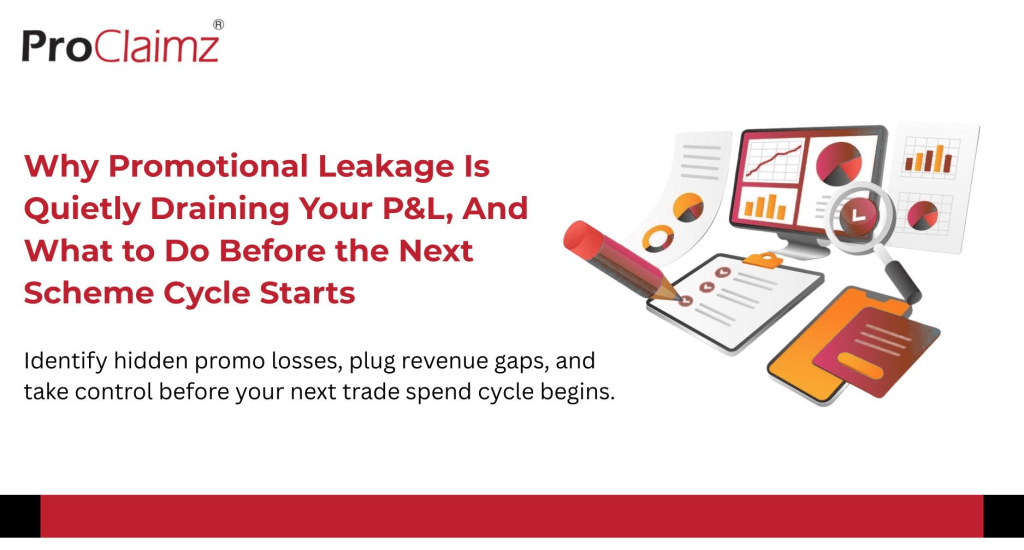
That is the number attached to promotional and scheme-related revenue leakage in the distribution industry. It is not a rounding error. At any meaningful revenue scale, it is a material financial exposure. And for most organisations, it remains unaddressed not because leadership is unaware of it in aggregate, but because no one has clearly mapped the specific process failures that are generating it.
This article maps those failures. And it explains why the conventional responses more approvals, more reconciliation steps, more audit staff do not solve the structural problem.
How Promotional Leakage Actually Happens
Promotional schemes in FMCG and healthcare distribution are commercially sound instruments. Volume incentives, loyalty programmes, product bundle discounts, gifting schemes tied to sell-through targets these tools exist because they work, when executed correctly.
The execution layer is where the problem lives.
A scheme is designed by the trade marketing team. It is communicated to the field force through circulars, emails, or in some cases WhatsApp messages formats that are inherently difficult to track for compliance or reference later. Each distributor interprets the scheme based on what they understood at the time of communication, which may or may not align with the intended parameters.
Field teams execute against their understanding of the scheme. At period end, distributors submit claims often in bulk, covering multiple schemes, formatted inconsistently. The manufacturer’s finance or trade marketing team reviews these claims against whatever records they hold, which may be incomplete, out of date, or simply difficult to cross-reference against actual transactional data.
Disputes arise. Some claims are legitimate and are paid correctly. Some are invalid wrong products, non-qualifying volumes, duplicate submissions, expired scheme windows and are paid anyway because the cost of disputing them is higher than the cost of settling. Some legitimate claims are rejected because the supporting documentation is inadequate, creating distributor dissatisfaction that has its own commercial consequences.
This sequence, running across hundreds of distributors and dozens of active schemes simultaneously, produces the 3% to 7% leakage figure. It is not a single failure. It is the cumulative financial cost of a process that was designed around human judgment and manual verification at a scale that those methods cannot reliably serve.
Why More Checkpoints Do Not Solve the Problem
The standard organisational response to scheme leakage is to add oversight. More approval layers on scheme definitions. Additional reconciliation steps before claims are settled. Dedicated audit functions to review high-value claims.
These interventions reduce the most egregious errors. They do not address the structural cause of the problem.
The structural cause is the absence of a shared, unambiguous, verifiable record of what actually happened at the transactional level during the scheme period. Without that record, every claim dispute is a negotiation between the distributor’s recollection and the manufacturer’s documentation and in that negotiation, the manufacturer almost always concedes, because the relationship is more valuable than the disputed amount.
Adding checkpoints to a process that lacks a transactional foundation does not create a transactional foundation. It creates a more elaborate version of the same process, with higher administrative cost and the same structural vulnerability.
The Shift: Validation Before Settlement
ProClaimz addresses the root of the problem, not its symptoms.
The platform integrates directly with Zylem-MIS the secondary sales database that holds invoice-level transactional records extracted directly from distributor billing systems. This creates a single, verifiable source of truth: a record of every transaction that occurred during the scheme period, at every qualifying distributor, for every qualifying SKU.
When a distributor submits a claim, ProClaimz validates it automatically against this record. The system answers a precise set of questions: Did this distributor sell the qualifying volume? Were the qualifying SKUs involved? Did the transactions occur within the active scheme window? Were the pricing or quantity thresholds met?
The answers are not interpretations. They are calculations against a transaction record that neither party can modify after the fact. The settlement figure that results is not negotiated it is computed. The distributor can see exactly which transactions qualified and why. The manufacturer’s finance team holds the same view. There is no information asymmetry for a dispute to live in.
This is the shift from reactive recovery to proactive margin protection. Instead of paying claims and recovering what you can later, you validate before you pay and settle only what the transaction data supports.
What This Does to Settlement Timelines and Why That Matters Commercially
In manual scheme management software, claim settlement is slow. Claims submitted at month end frequently are not resolved until the following quarter. This creates two compounding problems.
The first is financial planning: outstanding scheme liabilities that are not settled are difficult to account for accurately, which means they either distort accruals or generate surprises at period close.
The second is commercial: distributors who are waiting weeks for claim settlement have no visibility into when or how much they will receive. This uncertainty affects their willingness to invest working capital in executing the next scheme which undermines the commercial objective the scheme was designed to achieve.
ProClaimz compresses settlement cycles from weeks to days. The calculation is automated. The approval process runs through a defined hierarchy within the platform. The settlement is issued against a complete digital audit trail that satisfies both internal audit requirements and distributor queries.
Faster settlement is not just administratively cleaner. Distributors who receive accurate, timely scheme settlements are demonstrably more motivated to execute subsequent schemes with greater commitment. The trust effect is real, and it has a commercial return: better scheme execution means higher sell-through, which means the scheme ROI improves even before you have recovered a rupee of the leakage.
Organisations using ProClaimz have reported a 35% improvement in distributor satisfaction metrics directly linked to scheme transparency and settlement speed.
The Internal Control Dimension
ProClaimz also addresses an internal vulnerability that most scheme management processes carry: the absence of a controlled, documented approval chain for scheme definitions themselves.
Schemes that are designed informally, communicated verbally, or modified mid-cycle without authorisation are a persistent source of financial discrepancy. They create ambiguity about what the scheme actually said which is precisely the ambiguity that unauthorised claims exploit.
ProClaimz enforces a structured hierarchy of approval for every scheme definition. The parameters eligible SKUs, qualifying volumes, incentive structure, settlement method, active window are set through the platform and signed off at each level of the approval chain before the scheme goes live. Modifications require re-approval. Every version of every scheme is logged.
This is not bureaucracy. It is the internal control structure that makes the downstream validation process defensible and makes your audit trail coherent rather than reconstructed.
The CFO’s Case for Acting Now
If you are a business leader looking at this from a financial governance perspective, the calculation is direct.
Your organisation is running promotional schemes that are generating leakage somewhere in the 3% to 7% range. The exact figure depends on the scale of your scheme programme, the size of your distribution network, and the maturity of your current claim management process. What it does not depend on is market conditions. This leakage is internal. It is structural. And it is recoverable.
ProClaimz does not require your distributors to change anything. It does not require your field teams to submit more documentation. It extracts the transactional truth from systems that already exist and applies it automatically to the settlement process.
The reduction in claim processing time by approximately 60% frees your finance team’s capacity. The reduction in invalid claim payouts recovers margin directly. The improvement in distributor relationships improves scheme execution quality going forward.
These three outcomes compound. The question is when to start capturing them.
We will run a live demonstration using your scheme structure and show you exactly where the validation gaps in your current process exist.
Frequently Asked Questions
The main causes are invalid claims paid without verification, duplicate submissions that go undetected in manual review, loosely defined scheme parameters open to interpretation, and legitimate claims rejected due to poor documentation. Industry estimates put the combined leakage at 3 - 7% of earned revenue annually.