Most distribution management software does one thing well: it records what already happened.
An order was placed. A shipment went out. An invoice was raised. A payment was received eventually. The system captures these events faithfully, stores them reliably, and makes them retrievable on demand. And for a long time, that was enough.
It is not enough anymore. Not in a market where margins are being compressed from multiple directions simultaneously, where the cost of a slow decision is measured in stock write-offs and lost channel trust, and where the gap between what the system records and what the business actually needs has become a source of structural disadvantage.
The organisations pulling away from their competitors in 2026 are not operating better record-keeping systems. They are operating distribution infrastructure that thinks.
The Margin, Conversation Business Leaders Are Not Having
When senior leadership discusses eroding margins, the usual suspects are familiar: raw material inflation, logistics cost increases, pricing pressure from large retail chains, and the mounting cost of regulatory compliance. These are real. They deserve attention.
But there is a less visible and more controllable source of margin erosion that rarely makes it onto the executive agenda. It lives inside the distribution operation itself, in the administrative processes that run quietly beneath the strategic decisions and consume productive capacity in ways that never appear on a P&L.
Consider what a typical distribution operation looks like from the inside.
Purchase orders are raised manually, cross-referenced against supplier confirmations, and tracked through email chains. Inventory levels are updated by staff after each transaction a process that lags behind physical reality by hours or days. Payment collections are reconciled manually at month-end, creating a float of outstanding receivables that nobody can see clearly in real time. GST compliance is managed through a combination of software outputs and manual corrections. Pricing updates are communicated through field teams and implemented inconsistently across outlets.
Each of these processes is a controllable cost. Collectively, they represent a meaningful share of operational capacity research suggests the administrative load in distribution operations can consume up to 40% of productive time that is being spent on work that creates no customer value and returns no margin.
What Autonomous Distribution Actually Means
The phrase “autonomous distribution” is worth unpacking, because it is frequently used to describe things it should not.
Autonomous distribution does not mean removing people from the operation. It means removing people from the parts of the operation that do not require human judgment the repetitive, rule-driven tasks that are currently handled manually not because manual handling is better, but because no system has been configured to handle them automatically.
When inventory at a distributor location drops below a configured minimum, a well-designed system should trigger the procurement process without waiting for a warehouse manager to notice and raise a request. When a payment is received from a distributor, the reconciliation against the open invoice should happen in real time, not at the end of the month when someone has time to run the matching process. When a new pricing scheme is pushed from headquarters, it should activate across every sales point in the network simultaneously not cascade through a series of field communications that take a week to reach the last outlet.
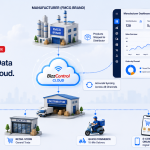
BizzControl is built on a microservices architecture specifically to enable this type of operation. Each function within the platform inventory management, procurement, pricing, financial reconciliation operates as an independent, continuously updated module. This design means the system can respond to operational triggers in real time, and it can be updated and improved without disrupting the rest of the operation. There is no maintenance window. No version upgrade that breaks existing workflows. The system is always current.
The Cash Flow Argument
For a CXO, the most immediate financial impact of BizzControl is on cash flow specifically, the working capital that currently sits trapped in administrative lag.
In a manual reconciliation environment, the time between receiving a payment from a distributor and recording that payment accurately against the corresponding invoice and outstanding balance can run to several days. Across a distribution network of any meaningful scale, that lag creates a persistent float of unreconciled receivables money that has technically arrived but is not yet visible as available capital.
Electronic reconciliation, built into BizzControl’s core architecture, closes this gap. Payment receipt and accounting entry happen in the same operational moment. Outstanding collections are visible in real time. The working capital that was trapped in the reconciliation process becomes immediately accessible.
The compounding effect of this over a quarter is significant. Faster reconciliation accelerates payment follow-up. Tighter follow-up shortens payment cycles. Shorter payment cycles reduce the working capital requirement of the business. This is a genuine financial improvement not a feature, a commercial outcome.
The Consistency Problem at Scale
Distribution networks have a consistency problem that is almost inherent to their structure. A company operating through 100 distributors across multiple states is, in practice, operating 100 slightly different businesses each with its own informal practices, pricing interpretations, documentation habits, and responses to manufacturer policy.
This inconsistency is not usually a result of distributor bad faith. It is a result of the absence of a system that enforces uniformity. When pricing updates are communicated through field representatives, the implementation rate and accuracy depend on the rep’s coverage, the distributor’s attentiveness, and the absence of any conflicting incentive. The result is a distribution network where your intended policy and the actual field reality diverge in ways that are difficult to detect and expensive to correct.
BizzControl’s centralised multi-sales-point architecture addresses this structurally. Pricing is controlled from a master admin panel and pushes uniformly to every node in the network. Inventory management methods FIFO or LIFO, depending on the product category are set once and applied consistently. GST compliance is managed systemically rather than left to individual distributor interpretation.
For a CXO whose distribution strategy is built on assumptions about consistent execution, BizzControl closes the gap between the strategy that exists in the executive presentation and the reality that exists at the outlet level.
From Recording to Deciding
The practical difference between a system of record and a system of intelligence is the difference between being told what happened and being shown what to do next.
BizzControl does not simply store distribution data. It uses operational triggers stock thresholds, payment timelines, inventory movements, pricing conflicts to surface the actions the business needs to take before problems develop. Automated procurement prevents stockouts. Flagged reconciliation discrepancies surface collection issues before they become disputes. Pricing inconsistencies are identified at the moment of entry, not when a field audit catches them months later.
In a market where the competitive window for action is shrinking, a system that identifies problems after the fact is not a competitive tool. It is a liability ledger.
The Real Opportunity
The margin crisis in distribution is not primarily a cost problem. It is an efficiency problem dressed in cost clothing. The costs are real but many of them exist because the processes generating them have never been automated.
BizzControl does not ask a business to operate differently. It automates the operational processes the business is already running, removes the human-error cost from the predictable tasks, and gives management the real-time visibility to make better decisions on the ones that require judgment.
That is the shift from a system of record to a system of intelligence. And in 2026, it is the difference that determines which distribution operations grow their margins and which ones manage their decline.
We will configure the walkthrough to match your network scale, industry, and specific operational pressure points.
Frequently Asked Questions
An ERP records what happened. Distribution management software actively manages what is happening live inventory, automated procurement, real-time reconciliation, and dynamic pricing so the business can respond before problems escalate rather than after they have been logged.